PIME new leadership

Ferruccio Brambillasca, 48,  born in Monza, Italy, has been elected by the General Assembly of PIME,, held in Rome this month, as the new General Superior. Currently he is leading the PIME community in Japan.

Ordained a priest in 1989, he served four years in south Italy. In that same period he studied at the Theological Faculty of Southern Italy where he earned a licentiate in dogmatic theology with a thesis in christology under the guidance of  the theologian Bruno Forte (now bishop of Chieti). From 1994 to 1998, he was assistant and educator in the Seminary in Pune, India, before going to Japan in 1998.  He has been in the Philippines in 2010  as a Resource Person at the  EUNTES  Center in Zamboanga City with his reflection on  Spirituality of Suffering.

Father Brambillasca was elected by a majority of two thirds. Accepting the election he asked, addressing to the other delegates of the assembly, for their prayers and cooperation. Then he thanked  father Gian Battista Zanchi, his predecessor as General Superior of  PIME, who led the Institute for two terms since 2001. Next to father Brambillasca the General Assembly has chosen as new Vicar General Davide Sciocco, 49, born in Parabiago, Milan, currently regional superior of  PIMEs in Guinea Bissau, Africa, and in the past director of the PIME’s Center of  Mission and Culture in Milan.

For the General Council were elected as well:

Gabriel Amal Costa, 53, born in Narayangoni (Bangladesh), the first Bangladeshi to join the institute in 1996. He has been a priest for 16 years. Between 1998 and 2003, he worked in Ivory Coast, Africa. At present he is the vice rector  of the International Theological Seminary in Monza, Italy.

Marco Monti, 49, a missionary in Thailand since 2001. Born in Bovisio Masciago (Varese, Italy), member of the Institute since 1999. He was the delegate of the Lay Missionary (LMD). Before joining PIME, he earned a degree in Business and Economics, and worked as a teacher. He is a member of the General Council on the Economy.

Paolo Ballan, 47,  a missionary in Bangladesh since 2003. Born in Cassano Magnano (Milan, Italy) has been a priest for 10 years. He is the youngest member of the General Council.

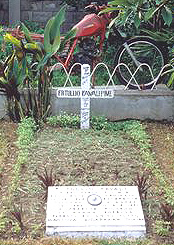
26 gennaio 1976

cocquio alessi

È morto sabato 26 aprile Francesco Alessi, uno dei primi missionari del PIME sbarcati nelle Filippine. Ha vissuto le lotte per la giustizia economica e sociale durante gli anni difficili della dittatura di Marcos. Di quegli anni Alessi ne fu testimone e protagonista. Ha saputo interpretare una vocazione missionaria, soprattutto nella parrocchia di Santa Cruz in Laguna, che poi ha determinato uno stile di vita e di lavoro anche per altri missionari negli anni che seguirono.

Bopha Report after 4 months

ListenerListener2Listener3Listener4Listener5

GREETINGS OF PEACE!
It has been 4 months since Typhoon Bopha (Pablo) struck the southeastern part of Mindanao. What initially looked like a hopeless situation is slowly being turned around by the resilience and determination of the survivors, the unflagging dedication of the volunteers, and the unwavering support of those like you who did not hesitate to share what you had for the survivors.

We would like to give you this report on the series of medical relief missions conducted by Balsa-Mindanao, a citizen-led movement that responds to disasters and of which the Fr. Fausto “Pops” Tentorio Foundation is a member.
These missions were made possible not by a single entity, but by the collaborative effort and support of a lot of individuals and organizations, which includes you. All the donations: medicines, finance, logistics, time, and morale, all contributed to the success of these missions. In the name of the lives with whom we had the opportunity to be a part of, we would like to extend our heartfelt gratitude for your support.

The often spoken line of the people was: what took us years to build, Pablo took away in 4 hours. It will indeed take years to rebuild but we are hoping to reassure the people that we will still be there with them in their efforts to rise from the ruins.

Our missions are still continuing but this time towards strengthening the community to regain or obtain their self-esteem and self-reliance. This summer, we will be launching trainings for Community Health Workers and more medical missions in the affected areas. We hope that somehow we can contribute to the communities’ efforts in Disaster Response and Preparedness by training these Community Health Workers to also become First Responders.

We know that you, too, will continue with us on this journey.

Thank you,

Fr. Peter Geremia, PIME

To fr. Tullio Favali

calungsod(from Olga Ong)

Tomorrow is the Death Anniversary of Father Tullio Favali. This song is for Saint Pedro Calungsod pero applicable rin kay Father and all the martyrs.

WITH LOVE AND FAITH (SONG FOR SAINT PEDRO CALUNGSOD)


I
To be the Lord’s companion and his friend,
you vowed to turn away from sin.
And with your passion and your piety,
you showed us how to hope and trust in him.

II
To spread the Lord’s salvation and his truth,
you traveled far to preach your dream.
And with your mighty selfless heart and soul, you showed us how to live and die for him.

REFRAIN
With your love and faith you conquered doubt and hate.
Lead us to God’s Word and bring light to the world.
Guide us all as we prepare our hearts and be your company
in mission to create God’s kingdom here on Earth.

III
To prove the Lord’s compassion and his strength,
you shed your blood to save a kin.
And with your loyalty and sacrifice,
you showed us how to laud and honor him.

REFRAIN 2x

God’s kingdom here on earth!

Fr. Peter Geremia: 50th year as priest

DynPicWaterMark_ImageViewer.phpKIDAPAWAN CITY  (MindaNew) — He was once a target for assassination, was arrested thrice and has been a recipient of death threats for taking the side of indigenous peoples in their struggles against human rights violations and in their assertions of their right to self-determination.
These  are the dramatic episodes of Italian priest Peter Geremia’s missionary life as he marks his 50th year as priest on March 30, a Black Saturday.
“My experience in the Philippines has been very dramatic,” says Geremia, a member of the  Pontifical Institute for Foreign Missions (PIME) who has spent 41 of his 50 year-priesthood in the Philippines,  36 of those years in Mindanao.
“When I came to Philippines, I was faced with the same challenges that the people were also facing,” the 74-year old missionary said.

After he was ordained as a priest in Detroit City in Michigan in 1963, Geremia taught history before he was assigned in Sta. Cruz, Laguna in 1972, the year martial law was declared. “We experienced flooding when I was in Sta. Cruz, Laguna” he recalled. Fr. Peter Geremia: 36 of his 50 years as priest spent in Mindanao. MindaNews photo by Keith Bacongco
Fr. Peter Geremia: 36 of his 50 years as priest spent in Mindanao. MindaNews photo by Keith Bacongco
Four years later, he was assigned in Tondo, Manila where he was involved in community organizing among informal settlers resisting relocation and pushing for recognition of their rights.
That same year, he was arrested along with other religious leaders for supporting the protesting La Tondeña workers

In 1977, Geremia was assigned to Siocon, Zamboanga del Norte where he spent the next three years until his transfer to the Diocese of Kidapawan in North Cotabato. In his early years at the Diocese, Geremia said then Bishop Federico Escaler, assigned him to Arakan town as his mission area. “My special interest became the organizing of Indigenous Peoples (IP),” he told MindaNews last Tuesday. Along with missionaries and Lumad leaders, Geremia founded the Tribal Filipino Program (TFP) in 1984 and served as its coordinator for 25 years. Within the first decade of his stint at the Diocese of Kidapawan, Geremia witnessed the struggles of his parishioners against human rights abuses allegedly perpetrated by government forces.

He served as parish priest of Tulunan in North Cotabato from 1980 to 1985 but also served neighboring Columbio town as part of his mission work. While in Columbio, Geremia stood up for the Lumads in their fight against the entry of a large-scale mining company. In 1992, he landed in jail after he was accused to be behind the raid on the National Food Authority (NFA) at the height of the drought, when Lumads were facing near  death from starvation. But after spending nearly a month at the provincial jail in Isulan, also in Sultan Kudarat, Geremia and 19 others were released on bail.

When his fellow missionary Fausto “Pops” Tentorio was killed in Arakan on October 17, 2011, Geremia volunteered in May 2012 to continue his pastoral work in Arakan where he now serves as  the assistant parish priest of Our Mother of Perpetual Help. He also serves as coordinator of the Tribal Filipinos Apostolate of the diocese.

Happy and Grateful

Lory Obal, executive director of the Intercultural Organizations Network for Solidarity and Peace in Columbio, who worked with Geremia for years says they are very happy and grateful because “he is an exceptional servant” and is “very consistent in his vows and commitment to the poor.” When Italian missionary Tulio Favali was killed on April 11, 1985 in Tulunan, Geremia said it was the turning point of his missionary life.

Geremia was the target of the paramilitary group of killers led by Norberto Manero, Jr., aka “Kumander Bucay.” But while waiting for Geremia to return to the convent from a pastoral visit, Manero’s group harassed the neighborhood, prompting one of them to rush to the parish to call for help. Father Favali rode his motorcycle to Crossing La Esperanza, where the Maneros later burned his motorcycle and shot him dead. “Favali was killed in my place. Obviously the plan was to eliminate myself not Favali. That kind of killing I felt responsible. It was a turning point, I could not go back immediately to continue my involvement,” he recalled.

Like the Passion of Christ

During his early years in Tulunan, Geremia said he pondered on the situation. “I kept on asking where was God? How can we respond to the situation of these people? Why are people facing death as if it were a collective suicide?” The missionary was referring to community leaders who were risking their lives in dealing with armed elements from both sides. He recalled that during the early stages of their community organizing, people had high expectations, were enthusiastic and expected that there will be changes in society. But somewhere along the way, some changed sides when “repression became so violent.” “But then those who continued with this kind of understanding, from the spiritual point of view, it is more like the passion of Christ. So many were attracted.” “How to continue the process of change that was initiated by Christ? Similar to our experience, how to continue after the killing of our companions,” he asked. .

Unite the PDOMES

With all the turmoil he encountered, Geremia said he draws inspiration and strength from what he calls the Poor, Deprived, Oppressed, Marginalized, Exploited and Struggling people (PDOMES). “I was given this kind of passion, charisma, restless. Out of my sense of being dissatisfied, I always have feeling that I am not satisfied with the present situation. I have this drive to see change. And this has become my passion that is also the Kingdom of God, to build this new society. To unite the PDOMES” he explained. One of the hardest aspects of being a missionary,  Geremia said, is “to understand God’s plan of salvation and to share with the people a sense of hope.” “God has His own plan of salvation. However, we, people, don’t understand very well. And we missionaries are supposed to make others understand. But we don’t understand also. So how to give this vision, this feeling that God is with the people who are building the kingdom of God, this new society, this new community. God is alive, Christ is alive,”  he said. His wish on his 50th year as priest? “I don’t wish to live so many more (years). But I wish for a quick death, not long, long suffering, and a chance to serve the people as long as I can,” (Keith Bacongco / MindaNews)

PURO ARTE the Book

A New Book by UCLABurnsA1hor-wl-cqp‘s Lucy Mae San Pablo Burns

“A magnificent work by a stellar Filipino/a American scholar attuned to the transnational and cross-racial dimensions of embodied struggle….The book displays the very astonishing creativity and sense of possibility that it brings to light.”
—Neferti Tadiar, Barnard College

Lucy Mae San Pablo Burns, an Associate Professor in the Asian American Studies Department at UCLA, has come out with a new scholarly work, exploring the emergence of Filipino American theater and performance from the early 20th century to the present. Puro Arte: Filipinos on the Stages of Empire stresses the Filipino performing body’s location as it conjoins colonial histories of the Philippines with U.S. race relations and discourses of globalization.

“Puro arte,” translated from Spanish into English, simply means “pure art.” In Filipino, however, puro arte performs a much more ironic function, gesturing rather to the labor of over-acting, histrionics, playfulness, and purely over-the-top dramatics. In this book, puro arte functions as an episteme, a way of approaching the Filipino/a performing body at key moments in U.S.-Philippine imperial relations, from the 1904 St. Louis World’s Fair, early American plays about the Philippines, Filipino patrons in U.S. taxi dance halls, to the phenomenon of Filipino/a actors in Miss Saigon. Using this varied archive, Puro Arte turns to performance as an object of study and as a way of understanding complex historical processes of racialization in relation to empire and colonialism

Francis

The cardinals of the Roman Catholic church chose as their new pope a man from almost “the end of the world” – the first non-European to be elected for almost 1,300 years and the first-ever member of the Jesuit order.

Jorge Mario Bergoglio, the archbishop of  Buenos Aires , becomes Pope Francis – the first pontiff to take that name – an early indication perhaps of a reign he hopes will be marked by inspirational preaching and evangelization.

Born in Buenos Aires, the new pope  was one of the five children of an Italian railway worker and his wife. After studying at the seminary in Villa Devoto, he entered the Society of Jesus in 1958. Bergoglio taught literature and psychology at the Colegio de la Inmaculada in Santa Fe, and the Colegio del Salvador in Buenos Aires. He was ordained to the priesthood on December 13, 1969, by Archbishop Ramón José Castellano. Bergoglio attained the position of novice master there and became professor of theology.

Esistenza

Benedetto XVI  si e’ ritirato. Ci mancherà? Ci mancherebbe altro. Ogni giorno ci ha interrogato circa i valori supremi, la visione dell’universo, il rapporto con Dio e i racconti fondanti della nostra fede.  Il suo pensiero e i suoi libri hanno popolato la Chiesa, ancor prima di diventare Papa. Per molti era una guida spirituale. Un vecchio missionario mi ha detto che le  parole di Ratzinger riuscivano a dare un senso alla sua solitudine di uomo senza una famiglia o, diversamente, a non subire troppo il peso della collettività. Ora e’ preoccupato e continua a domandarsi se anche la Chiesa non sia destinata alla pensione, peggio alla sclerosi. Cioè all’inaridimento delle risorse per il prosciugamento delle antiche sorgenti di pensiero.  Il risultato sarebbe un fare meccanico e ripetitivo in una atmosfera di  grande tristezza. “Se poi nella Chiesa cominciasse ad albergare solo la nostalgia per il passato?”, gli ho domandato. ” Albergare? Um! Potremmo sempre diventare dei custodi di un grande museo allargato”, mi ha risposto. ”Ma se poi nelle crepe di questo antico museo si infiltrassero pericolosamente anche dubbi e sprechi? “. Allora, meglio affrettarsi all’uscita d’insicurezza”, ha aggiunto sorridendo.

Da oggi il vecchio Papa lavorerà da solo. Incerto, ma senza la preoccupazione dei grandi progetti.  Libero nei movimenti e in contatto con il mondo solo per mezzo di una agile ed aggiornata rete comunicativa. Um! Forse ci vuole mostrare una via a noi che siamo sul viale del tramonto.  Immagino:  … quello di accettare che, in fondo in fondo, siamo creature solitarie. Che dobbiamo saper nutrirci da soli, senza affidarsi troppo alle strutture politiche o religiose. Ovviamente non nelle emergenze.  Il tempo e’ a nostra disposizione. Da far fruttare. Per esempio, cominciando a rovistare tra le secolari e incolte sterpaglie, a volte di rovi,  che avvolgono le fondamenta delle nostre istituzioni. Oppure rileggere i brevi messaggi infilati, chissà da quando, nelle fessure dei vari muri del pianto della nostra esistenza.  Del resto ci deve essere ancora spirito santo, moralità evangelica e valori umani non ancora dispersi nelle infiltrazioni, nei dissesti e negli impianti sotterranei del nostro mondo. Chi meglio di un vecchio potrà trovarli, dopo la sua lunga pratica di vita?  E chissà! Magari in questa esplorazione il vecchio potra’  incontrare anche  eremitici mediatori che sanno indicare l’accesso alle fonti. Quelle che danno cristiana giovinezza anche a un mezzo metro cubo di inaridita e prosciugata umanità.